On AI
Is AI Thirstier than Your Morning Coffee?
Comparing the water and energy footprint of a mug of coffee with chat, agentic and Claude Code sessions.

People often ask how much water and energy AI uses, and the answers they get are usually "a few drops per prompt" or "a bottle of water per email". Neither means much on its own, so I wanted a baseline most of us already have a feel for: a mug of coffee.
The coffee baseline
The headline figure for coffee is about 140 litres of water per cup, from the Water Footprint Network. But most of that is "green water", rain that falls on the coffee farm and would have fallen anyway. Data centres use "blue water", drawn from rivers and aquifers and evaporated in cooling. So to compare like with like, I counted blue water only.
A life cycle assessment of coffee puts that at 3 to 10 litres per small cup. Scaled up to a 340 mL mug, which uses roughly two and a half to three times the grounds, that comes to about 18 litres of blue water. For energy, a review of coffee life cycle studies works out to roughly 250 to 600 Wh per mug. I used 450 Wh.
The AI side
Google says its median Gemini prompt uses 0.24 Wh and 0.26 mL of water, but a single prompt no longer describes how many of us use these tools. Reasoning models and agents send dozens of long requests for every message we type. So I compared coffee with whole sessions instead, using figures from Microsoft Research and Simon Couch's analysis of his own Claude Code logs. To convert energy into water I used 2 mL per Wh, which covers both cooling and electricity generation.
What the numbers say
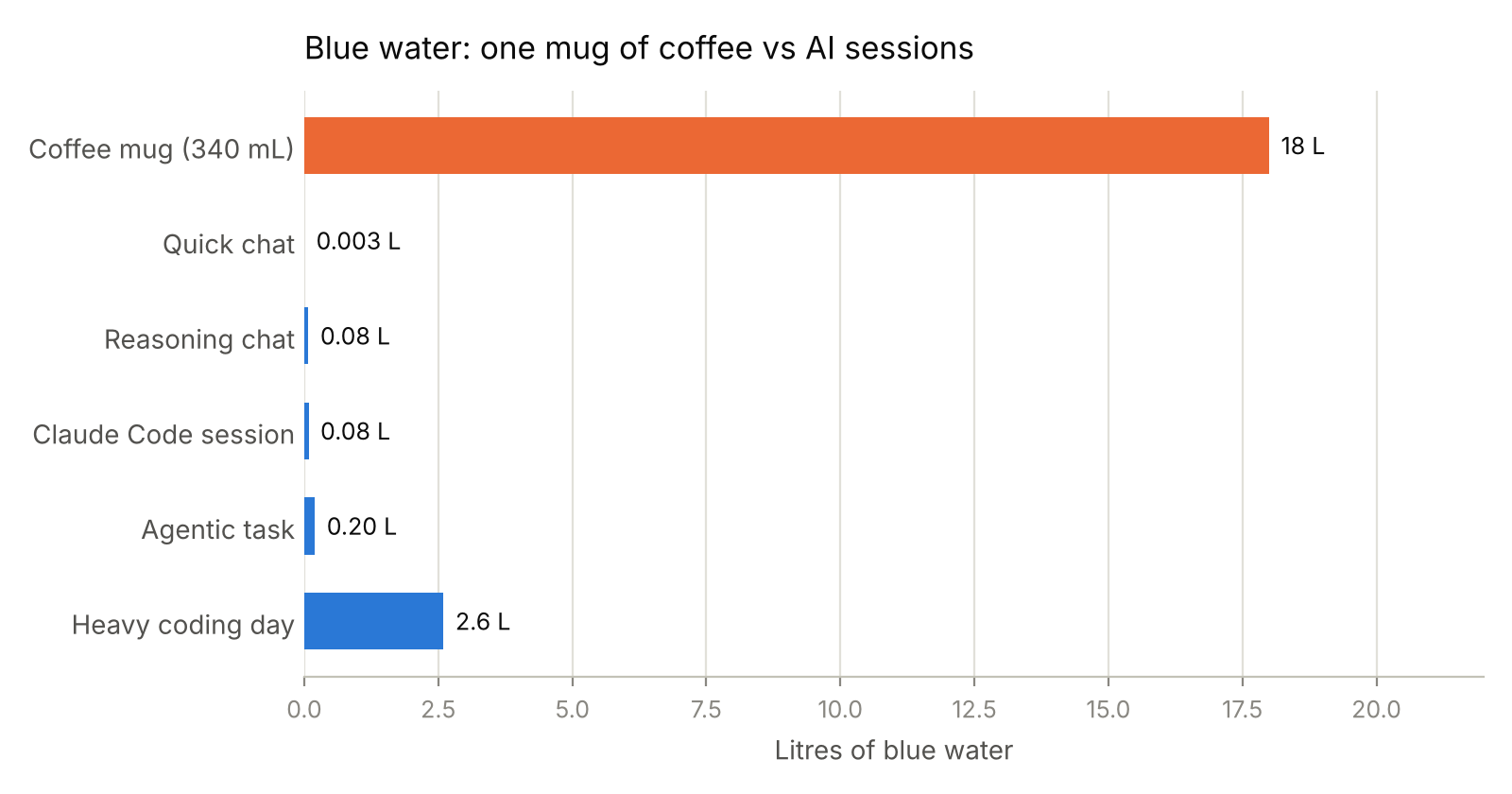
On water, coffee wins easily. One mug uses about seven times more blue water than a full day of heavy agentic coding, and a quick chat uses roughly a six-thousandth of a mug.
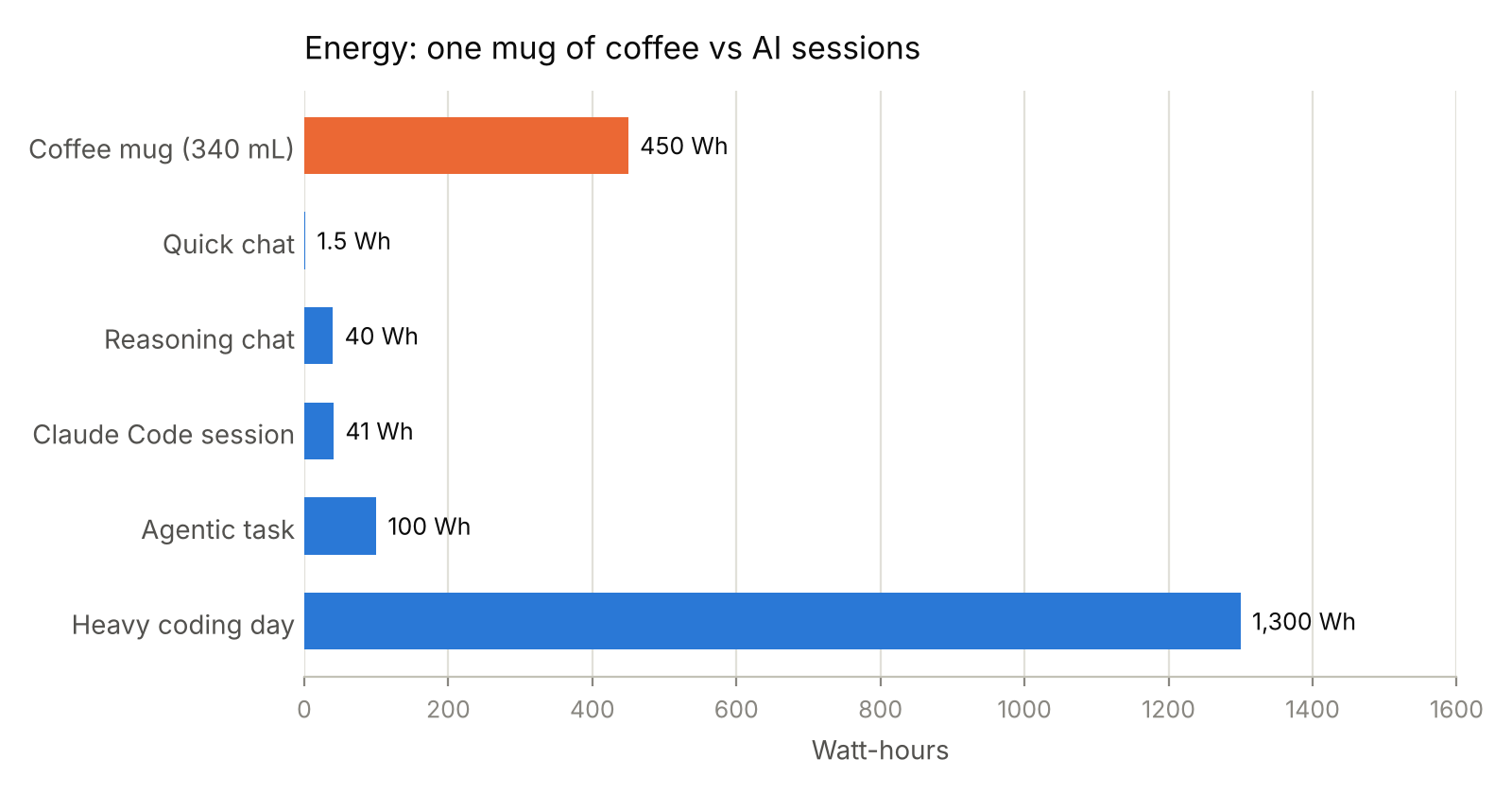
Energy is closer. You'd need about eleven reasoning chats or Claude Code sessions to match one mug. A heavy coding day, though, uses about as much energy as three mugs of coffee. That's not nothing, but it's in the same range as running a dishwasher.
Caveats
These are estimates stacked on estimates. They cover inference only, not training or hardware. When Mistral published a full life cycle assessment of one of its models, training made up 91% of the total water use. The water-per-Wh factor also varies widely by region and power source, with published estimates ranging from 1.8 to 12 litres per kWh. And if you add green water back in, coffee jumps to roughly 350 to 400 litres per mug.
Still, the broad picture holds under most assumptions. On water, everyday AI use is small next to the coffee most of us drink while using it. On energy, heavy agentic use starts to add up to something you'd notice on a household scale.
It's incredibly important that we reduce the resource usage of technology. Yet it's also vital that we understand this usage within the larger context of energy usage in our economies. Although these numbers are rough estimations, it gives one an idea at least of the order of magnitude of resource usage of this technology. Without this like-for-like comparison I find it's difficult to understand where and how we can reduce our resource usage overall. Note: the research and much of the writing of this article was conducted with Claude.